School, Writing

Dirty Monkeys

This year I purchased a magnetic poetry set for my classroom. I set aside a corner of the white board thinking it would be a fun thing for students to do -make sentences and poems in between their assignments, during homeroom, etc.

Some magnetic poetry sets have themes but this one, which I purchased at a yardsale, seemed to be pretty general. I scanned for any blatantly inappropriate words and then let them have at it.

Quickly I developed a secret little corner of the board where the “bad words” were banished. Some were obvious. “Blow, Butt, and Breast,” quickly made their way to the corner. What I didn’t anticipate was the students’ diligence and creativity in finding ways to make ordinary words dirty.

The bad word list grew longer:

Blow

Butt

Breast

Sausage

Kiss

Hole

Sweat

Slam

Meat

Rocket

Brown

All these words are innocuous enough on their own, but put together they say things like “Blow my brown meat rocket.”

The words that are left are pretty much rated G. However, every once in a while they come up with something truly unique such as yesterday’s contribution.

“I remember tall wild monkeys tongue fiddling him.”

I left it up there. After all, it’s poetry.

Writing

Be a character not a camera

Recently I cleared off my desk and disposed of quite a few little scraps of paper containing notes that at one time or another were vital to something I was writing. It could be Go West or my current, yet unnamed, wip.  These notes are usually scrawled on return address envelopes, the backs of receipts, or old grocery lists.  They usually contain the first few sentences of an important scene that’s floated into my brain when I’m driving or in the middle of teaching a genetics lesson at school.

One of these little gems I uncovered simply said, “Be a character, not a camera.” I have a tendency to write my main characters as observers. Too often it seems, they are the person the story happens around.  This makes my early readers wonder, who is this person? Is this really their story?

I think I have a tendency to do this for two related reasons. The first, is that regardless of age or gender, or even the point of view I’m writing from, I most closely associate myself with the main character.  Therefore I’m a little reluctant to make them too deeply flawed.  I’m oddly protective of them. I’m nervous about creating too much conflict around them.  I know, it’s a problem -since conflict is the essential heart of all good stories.

The second, very closely related reason, is just being the author in general. One criticism of my first completed novel (not the one that sold) was that the voice was too “authorial” in places. As with all criticism my first instinct was to reject it outright.Stupid criticism!  But with time and distance I saw what they were talking about. Sometimes my main character sounded like my main character, and sometimes she sounded like “THE AUTHOR”!  Just a bit too worldly, wise and omniscient to be a 14 year old girl living in a giant landfill.  Oops.

So as I’m currently drafting a new book, I’m trying to hold this in mind. I’m trying to let my main character be herself and not some idealized version of herself.  I’m working on lists of things I know about her, regardless of whether they ever make it into the actual writing.  (There are lots of lists like this available on the interwebs. Here’s one.) The more fully developed she is in my mind, the easier I think it will be to distinguish her voice from mine.

Writing

Writing Conference Part II

Okay, admittedly I was a little cranky in that first post. I’ll chalk it up to re-circulated hotel air. Here are some of the writing and learning highlights of my weekend.
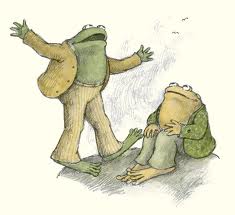
Sara Zarr‘s keynote in which she referenced and read from Arnold Lobel’s classic Frog and Toad stories was a definite highlight. Sara managed to pull gems about self-discipline, (Frog and Toad make cookies and can’t stop eating them) self aggrandizement, (Toad has a dream in which the better and more impressive he becomes, the smaller and more insignificant Frog becomes) and surprises (Toad loses his “to-do” list and can’t figure out what to do with himself) into a wonderful speech that was both wise and accessible at the same time.  So that was good. Plus Sara Zarr is one of my personal writing heroes so I was pretty psyched to just sit and listen to her talk.  I also went to her workshop called “Author Charm School” and had her sign my book. *bats eyes, heart flutters*

If you haven’t read her books, I recommend them all.  Particularly this one and this one.

Another highlight was a workshop on revision by Kate Messner. This workshop was exactly what a workshop should be; great ideas, intermittent times to try them out in short writing exercises, and chocolate. Kate is a wonderful children’s author and former middle school teacher. Nuff said.

Kate also shared her TED talk with the conference and an incredible resource she’s creating called Kid Sourcing.  Kid Sourcing provides ways for kids to get involved solving real-world problems and participating in actual scientific research.  Teacher friends pay attention -this could be an excellent classroom resource!

One final highlight was a workshop on developing character using improvisation activities by Jen Nails. This workshop got us up and moving and doing all manner of ridiculous activities.  It was a terrific energizer and a good reminder that we humans (writers too) are more than just brains on a stick. Plus I got to sing “It’s a Hard Knock Life” in front of 50 strangers. -You know I hated it 🙂

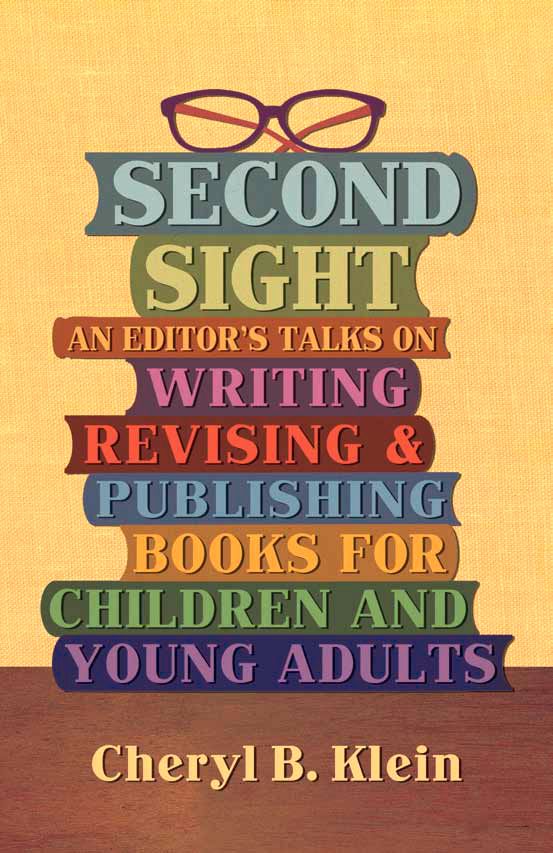
Lastly, I  walked away from the conference with a few good books including  Cheryl Klein’s Second Sight.  Klein is an Children’s book editor who has compiled her best talks, blog posts and advice into a (so far) fabulous resource.

Best of all, when I got home the kitchen was clean, there was a fire in the woodstove and a wonderful greeting from husband and daughter!

Writing

Writing Conference Part I

For the last 2 and a half days I’ve been immersed in the world of the New England Society of Children’s Book Writers and Illustrators. It’s a mouthful and it’s equally ridiculous as an acronym NESCBWI. Anyway! Being here, and being completely immersed in a world where everyone writes books for kids has been luxurious and unbalancing all at the same time. Here are a few things I’ve learned (without breaching the rights of the presenters which I was sternly warned against in the conference’s blogging policy.)

I should probably have business cards. (Although, other people’s business cards just collect in my bag along with various pens that don’t work and a bag of crumbled cookies I’ve been hanging onto for 9 months just in case.) Mostly I just remember people’s names and then find them on twitter. I’m @sashikaufman by the way.

A workshop is only as good as the presenter. A workshop can sound incredible on paper and be as dry as the chocolate cake they served at lunch on Saturday. (And believe me, my standards for chocolate cake are not that high.)

Shmoozing at conferences is a good way to meet interesting people who share your interests.  -I met some great people from Maine who are kid lit. writers.  It’s also exhausting as hell and sometimes I’m just as happy to eat an eggplant parm sub in my room and watch the Amazing Race on my laptop.

Gosh, this sounds a little negative so far. It’s not meant to be. So far this weekend has been eye-opening and creativity-sparking. I feel lucky to be here and I’m looking forward to one last day of learning. Perhaps that will be the focus of part two.

Writing

Word Fool

It’s been a little while since I posted and happily that’s because…I’ve been writing.  A lot! I joined up with some writer friends to participate in a writing goal challenge (called wordfool) orchestrated by the fabulous Bria Quinlan.  The challenge was to pick a writing goal and try to meet it 6/7 days a week for 3 weeks. There were points, and incentives and a lot of silliness on twitter. But the most important part was that there was community.

If you’ve ever set any kind of goal for yourself (writing, exercise, flossing) you know that it’s always better to do it with someone. It’s called accountability.  And oddly enough one of my challenge buddies posted recently about it here.  But more than just accountability, it’s nice to have the community.  You know that someone cares if you put off watching tv, or bathing your kid so you could get your 500 words in.

My goal was small. I committed to a page a day, knowing that I had parent-teacher conferences and both my husband and daughter’s birthdays in a small period of time.  And I didn’t make my goal every day.  But I did pretty well. 6/7 the first week, 5/7 the other two weeks.  But most importantly I got through a confusing section in my current wip which had me stuck for quite a while.  And I think I did it because of goal-setting and good old fashioned Butt In Chair -see my post on potty training.

What goals have you set or accomplished lately?


Reading, School

When I Grow Up I Want to be Harry Potter

Today in school, apropos of I can ‘t remember what, a student asked me with disbelief and maybe even a tiny bit of disdain in his voice, “Did you want to be a teacher?  I mean like when you were younger?” I laughed out loud at the tone in his voice and the utter skepticism that anyone could choose this profession intentionally.  And there are moments when I wonder similarly, but regardless the answer is no.

I liked school.  I liked the structure and the tasks with neat beginnings, middles, and ends.  I loved to read, I was curious and had a great memory for facts.  So school was a relatively fun place for me.  But I never dreamed of being a teacher.  Even when I decided to go back to school and get my teaching certification, it wasn’t because I wanted to be a teacher.  I did it because I never wanted to work at a desk.  I did it because I wanted every day to be different.  I did it because I thought I could be a consistent adult for kids who might lack one in their lives.  I did it because adolescents make me laugh and think.

But never because I wanted to be The Teacher.  When I see little kids playing school or teacher, they inevitably end up bossing their friends or stuffed animals through a series of tasks.  Unfortunately, I know teachers like that too.  They are teachers who want to be The Teacher.

Which brings me to one of my favorite Harry Potter quotes.  It comes from the King’s Cross chapter in the final book of the series.  Harry is talking to Dumbledore about why he never pursued the position of Minister of Magic.  Dumbledore (also a teacher incidentally) answers him by saying, “It is a curious thing Harry, but perhaps those who are best suited to power are those who have never sought it.”

Curious, and true.

Reading, Writing

Voice versus volcanoes

I recently checked out two YA books from the library.  Both have been on my “to-read” list for a while, though admittedly one is by a favorite author.  I had high hopes for the first one.  It was a post-apocalypse survival story that begins with the eruption of a super-volcano!  I don’t know what happens next.  I put it down after about 15 pages.  It didn’t matter how exciting or action-packed the premise was.  The writing wasn’t there for me and neither was the voice.

Nothing much happened exactly in the first few pages of the second book.  A girl gets on to a train.  Another girl is angry about the loss of her father months before.  But the voice is there.  Two voices, in fact since the book is written from alternating perspectives.  I’m immediately drawn right in.  I tear through the book over the course of the next 3 days.  I need to know what’s going to happen to these characters.  What will they realize?  How will they grow and change?  There are no volcanoes, but when someone writes about life in a way that is so universal and yet specific and detailed to the characters they create, so that the reader feels they are somewhere new and somewhere familiar all at the same time it’s better than a volcano or an earthquake or a vampire zombie attack…..at least for me it is.

Writing

Mystery man in my life

Many of you have asked questions about my publisher Carolrhoda Lab and editor, Andrew Karre.  All things Carolrhoda are being featured on this blog this week; February 27th- March 2nd, starting with a great interview with the amazing Andrew.   Yup, it’s called Bite My Books.  Nice.

Sneaky Motherhood, Writing

Potty training and writing

There may be a lot more overlap between parenting and writing than I’ve stopped to consider.  I’m sure there are people way more qualified (more books, more kids) than me to draw the comparison.  But recent experience with potty training made me realize something of huge import to both processes; sitting in the chair.

Butt in chair, is a piece of writing advice I’ve heard often enough that I have no idea whom to credit with coining the phrase or making it famous.  It is the ultimate truth about writing, the most obvious but unavoidable truth.  It is the answer to all those people who ask you, “How do you find the time?”  Butt in chair is what separates people who write books from people who talk about writing a book.  Perhaps more than talent or other circumstances.  Butt in chair is a great equalizer.

My daughter is experimenting with using the potty.  She loves the praise she gets even for trying but what she really lacks at this point is the focus and desire to sit down and get the job done consistently.  Too often she’s distracted by flushing the big potty, reading a book, a wayward toy left by the tub, or just a glimmer of sunlight in the window.  She hops up, declares she’s all done and is on to the next task.  I’m not worried.  I know that when she’s ready, she’ll commit.

When she’s ready, I’ll explain to her the importance of Butt In Chair for accomplishing those things that are truly important to you.

Reading, School

Middle school existentialism

I’ve been reading The Giver every year I’ve taught 8th grade English.  And every year I love it.  I love the conversations it provokes from my students; conversations about the importance of making your own choices, about safety versus freedom, about the meaning of life itself.  And inevitably we talk about death.

Those who live in the sheltered world of the Giver’s community know nothing of death.  They believe that people are “released” from the community and go to “Elsewhere”.  In my class we talk about denial, about grief, and about the role of religion in explaining the unknown.  It’s heavy stuff.  Today it provided this little gem of a conversation between two students.

Kid 1: Death is totally going to suck.

Kid 2: Yeah remember before you were born, it’s like that, nothing. Totally boring.

Kid 1: Yeah, it really sucks.

I’m sure there are scholars who could say it in a more complex way, but not nearly as entertaining and probably just as enlightening.