Reading, Writing

Cardboard characters; worse in YA?

I’m pretty picky when it comes to reading fiction.  I don’t read trashy books for fun the way I watch trashy movies.  However when I read YA, I’m more open-minded.  Maybe because I write YA I want to get a broader sense of what’s out there.

I think it’s fair to say that in YA there’s more attention paid to plot than language.  YA readers are generally more interested in what’s happening than the way it’s happening.  But why all the 2 dimensional characters?  This is something that I do think kids are aware of.  When they’re presented with really well drawn complex characters they like them.  They say things like; “the book was very real” or “the characters were like real people” or “the characters were interesting”.  Young adults are highly attuned to authenticity.   Regardless of genre, regardless of how many trolls or elves or dueling balrogs you have in your story, you have to have Frodo or Harry Potter, Percy Jackson, Bella Swan, or Katniss Everdeen.  It’s not just the story, it’s their story, and you have to want to tag along with them for 200-600 pages.

For every great YA character there seem to be hundreds of “popular girl cliques” or “sad fat girls” or”football player heroes”.   Are stereotypical characters more prevalent in YA than adult fiction?  I’m not sure.

Favorite YA or other fictional character?
Reading, School

Goodreads for all

I recently started sharing book recommendations and reviews with my students on Goodreads. They are required to keep a reading list through out the year and I thought this would be a fun way to take it on-line and give them access to each other’s lists.  If you don’t have experience with goodreads, it’s basically social networking for book nerds.  You can add and review as many books as you want and when you “friend” people you can see what they’re reading and check out their reviews.

I thought about creating a separate account when I started sharing with my students but due to time constraints and laziness, I just use my personal account.  It’s not like I’ve reviewed Anais Nin on there or anything.  Besides, most of them are too busy messaging each other to care what I’m reading.  I had no idea there was even a messaging feature until my students found it within 4 minutes of being introduced to the site.

This is a long introduction to the idea of older versus younger YA.  Often on book review sites  books for young adults will be described as 15 and up.  I teach 12-14 year-olds with varying levels of life and literary experience.  Sometimes I will get really excited about a book and describe it to my students only to realize that it’s probably not a book they should read without parental approval.  Oops.

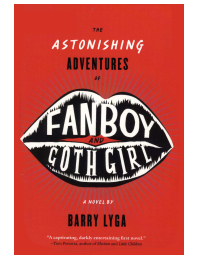
My most recent YA read The Astonishing Adventures of Fanboy and Gothgirl is one of those books. I read it and would recommend it highly…but only if you’re 15 and up.

Reading, Sneaky Motherhood

More shifts in perspective

When I started writing this blog I didn’t have a baby.  When Eliana came along I still didn’t want to blog about motherhood.  There are enough Mommy blogs out there (aspiring writer blogs; there’s a real shortage there).

But regardless, being a mother colors and shades every part of my life, so occasionally it will sneak its way into a post. Most recently, I’ve noticed that being a mother has changed the way I read.  When a parent and child were separated in a book I was reading, I always identified with the child.  I felt their fear, but also their resilience and the tinge of excitement that comes with being on your own.  Now I might read the same passage and feel nothing but terror for the child set adrift in the world without the parent.  I feel the pain of separation much more viscerally than I ever did before.

The circumstances are the same.  I think I feel it differently because a child doesn’t assume they can control the world.  A child is more content to adapt and move with the current than swim against it.   I should know better than to expect to control the forces of nature that will affect my daughter or myself.  I would like to read that way and I would like to live that way as best I can.

Reading, Writing

The Holidays

I love holiday movies.  I can’t help it.  They’re shmaltzy and predictable but I just can’t help myself.  I like the funny ones, the dramatic ones, mainstream and independents.  Everything from a Christmas Story to David Sedaris Holidays on Ice. There’s just something about celebrating holidays that seems to encapsulate a certain amount of relational humor and drama.

My current work in progress takes place between Thanksgiving and New Year’s Eve.   The story kicks off with a particularly painful holiday in which the main character’s visiting cousin pees in his bed and his mother lies to him about the death of his beloved grandmother.

Do you have a favorite holiday moment; fictional or autobiographical?

Reading, Writing

When is sex allowed?

When is sex or even heavy petting (yeah, that’s right I’m bringing this phrase back) allowed in YA fiction?

  • When someone is dying or dies shortly afterward.
  • As a cautionary tale about teen pregnancy.
  • When it’s somehow non-consensual.
  • When it’s the biggest mistake of the character’s life.

Why do most teenagers have sex?

  • Because they’re curious.
  • Because they’re bored.
  • Or God forbid because it feels good!!!!

This side is somehow less “ok” to write about.  One of the refreshing things about a book I read recently called The DUFF was that it dealt with teens who were having sex and enjoying themselves without the world ending.  Now I don’t necessarily think all, or even most, teenagers are ready for sex.  But they are capable of having healthy relationships that are sexual in some way.  So why isn’t it written about?

Reading, School

Cultural hypocrisy?

I admit that at times I’ve been lax with the books I lend to my students.  I forget that being raised by hippies means I was allowed to read pretty much whatever I want whenever I wanted.  On occasion I’ve had to deal with an angry parent who felt the subject matter of the book I lent out was too much (It’s almost always about sex.)  Keep in mind these are all YA books.  It’s just that some YA books are more appropriate for the 12-15 set and some are more appropriate for the 15 and up crowd.

I take full responsibility here and try to get a note from parents whenever kids pick up one of my books from the “special shelf”.  But it’s hard to keep on top of it and frankly I get really excited whenever anyone shows excitement about reading.  Reading can be a hard sell in the days of IM, video games, movies, and youtube.

So I find it interesting that the same parents who object to sexuality in their child’s reading material are fine with the contents of The Hunger Games.  I have a number of 8th graders reading this book.  I read it.  It was a gripping page-turner.  But it is violent and graphic and disturbing.

Sex, drugs, or violence?  What would you let your 8th grader read?

Reading

Reading on the edge

This is not a post about banned books week.  Although I do find the idea of banning books to be pretty abhorrent.  No, it’s about reading on the edge of your comfort or interest zone and the surprises that can be found there.

I recently finished The Book of Lost Things by John Connolly.  I picked it up because of a favorable staff review at my local bookstore.  I don’t normally buy books this way.  Usually if I’m not sure about an author I’ll go to the library first.  Anyway, it turned out to be more of a fantasy meets gothic fairytale than I expected.  (I don’t read adult fantasy books, though occasionally I dabble in the realm of fantasy YA.)   I don’t know if I can say I liked it, but I enjoyed it more than I thought I would.  It was certainly engaging and fun to read something so different from what I normally enjoy.

Read anything lately that took you out of your comfort zone?  Was it something you’d recommend?

Reading, Writing

YA Pet Peeve

It really annoys me when YA authors confuse clothing with characterization.  For example, telling us the character wore an Abercrombie sweatshirt and Lucky jeans does not tell me what they are like.  I think this is more prevalent in YA fiction because adult authors assume that teens are hyper-conscious of their looks and pay attention to brands.  They do.  But that doesn’t mean that they need it (or want it) in their literature.  The exception would be a single piece of clothing that really does characterize someone and is linked to other character traits.

For example: Every day he wore the same black hooded sweatshirt with the frayed cuffs and the broken zipper.  The dark color hid the saliva marks where he nervously chewed his sweatshirt strings, hoping the teacher wouldn’t check their homework.

Reading, Writing

Human mud

Really liked this quote from an interview with author David Mitchell about writing and how his new book is more preoccupied with what he describes as “human mud” and less experimental in its structure and form.

“The reason we love the books we love – it’s the people.  It’s the human mud, the glue between us and them, the universal periodic table of the human condition.  It transcends.”

Read the whole article in last Sunday’s New York Times magazine.   I read his book Black Swan Green and I’m interested to check out Cloud Atlas.